

Reviewed by the SimplexHealth Water Testing Team
SimplexHealth has specialised in water testing products and laboratory water analysis since 2010
Do you have a water leak at home or business and would like to establish the source of it?
When you discover a water leak inside or outside your house or business it can be difficult to find out where the water is coming from. A simple and cost effective way is to test the water. Once you have decided what type of tests to carry out, check Process at the bottom of this article.
FAQs
How can I tell if a leak is coming from my water pipes or the ground?
Test the water from the leak and compare it against samples from your tap water, rainwater, and any nearby groundwater. Mains/tap water usually contains chlorine (added for sanitary reasons) and has a pH between 6.5 and 9.5, while rainwater is typically more acidic (pH 4-5) and won’t contain chlorine. Comparing the leak sample’s chlorine and pH readings to one of these sources usually points to the origin.
Does tap water always contain chlorine?
Most treated mains water does, typically between 0.2 and 2.0ppm. The WHO’s health-based guideline maximum is 5ppm. If your leak sample tests positive for chlorine, it’s most likely to be from a water supply pipe rather than the ground or rain.
Why might a chlorine test not detect a leak from a water pipe?
Chlorine evaporates from standing water within about 24 hours. If the leak water has been sitting for a while before you test it, the chlorine may already be gone even if the leak is from a mains pipe — in that case a pH or nitrate/alkalinity test is more reliable.
What does an acidic pH reading suggest about a leak?
Due to naturally occurring acids a lower pH (around 4–5) is typical of rainwater. However, if leak water has passed through soil, concrete, or earth before reaching you, it can pick up ions that shift its pH, making the original source harder to pin down from pH alone.
Can nitrate or nitrite levels help identify a leak source?
Yes — elevated nitrates and nitrites often point to agricultural runoff, sewage, or fertiliser contamination rather than clean mains or rainwater, so testing for them can help rule sewage or ground contamination in or out when chlorine and pH tests are inconclusive.
How do I test if a leak might be coming from a sewage or waste pipe?
Test the leak water for coliform bacteria (or a lab test for Coliform/E. coli & Intestinal Streptococci). The presence of faecal indicator bacteria suggests the leak is from a sewage source rather than clean mains water or rainwater.
Is home water testing conclusive for finding a leak’s source?
Not always. If chlorine has fully evaporated or the pH levels of possible sources are too similar, test results alone may not give a clear answer. In these cases, more than one test type is usually needed, and a laboratory comparison test (checking multiple parameters across water samples) gives a more reliable result.
What’s the best way to compare water samples to find a leak’s source?
Take samples from your tap water, rainwater, and any nearby groundwater, plus a sample from the leak itself. Test all of them for the same parameters (chlorine, pH, and if needed nitrate/alkalinity or bacteria) and compare the results — a close match between the leak and one source is the strongest indicator of origin.
These are our recommended water leak & tap tests to check and identify if its ground water or from a water supply pipe.
Option 1: Total Chlorine test
Treated water is likely to contain chlorine, which is added to the mains water for sanitary reasons. Therefore, a good test to use is the Total Chlorine test. Chlorine levels in drinking water are typically between 0.2 and 2.0ppm. The World Health Organisation has set a health based guideline maximum value of 5ppm (mg/l) for chlorine as a residual disinfectant in drinking water. Total Chlorine measures the amount of free and combined chlorine in water.
A chlorine test works best on fresh leak water, since chlorine typically dissipates within 24 hours of standing (see FAQ above). If the leak water has been sitting for a while, try the pH or nitrate/alkalinity test instead.
Option 2: pH test
Another option is to test the pH using wide range water pH test . The pH of water varies depending on its origin. Tap water should have a pH of 6.5 to 9.5. Rain water is usually more acidic, 4 to 5, due to its origin (mainly because of the presence of two strong acids, sulphuric acid (H2SO4) and nitric acid (HNO3)).
In cases where the water from the leak or flood travels through materials like earth, concrete or soil, it might pick up ions which will influence the pH – hence making it harder to determine the original pH and where the water has come from.
Option 3: Nitrate/Nitrite/Hardness/Alkalinity test
If the chlorine and pH tests are inconclusive then an alkalinity* or 5in1* test (pack of 25 tests or 5 tests) for nitrates, nitrites, hardness and alkalinity may provide further information. The main causes for nitrates in water include agricultural activity, inorganic nitrogenous fertilisers and manures, erosion of natural deposits, leaking from sewer tanks or sewage. The maximum contaminant guideline for nitrate (as NO3) in tap water is 50mg/l and for nitrite (as NO2) is 0.50mg/l.
(*please note, that the pH range in this particular test does not cover the acidic range and hence might not show acidic rain water. In this case the wide range pH test is recommended.)
Laboratory tests are often used when it is more tricky to establish the source of a leak or when a laboratory result is required as part of evidence:
Option 4: Water Suite 8-in-1 laboratory test
This laboratory water test checks the levels of pH, total hardness, total dissolved solids (TDS), conductivity, calcium hardness, M. alkalinity, total chlorine and chloride. Analyse 2 or more water samples to establish if they are from the same source or not. Take a water sample from the leak as well as surrounding water sources (ie ground water, tap water etc) so the results can be compared to each other. This lab test is recommended where the water from the leak is fresh and it has not travelled through other materials like soil, concrete or earth.
Option 5: Water Suite 9-in-1 laboratory test
The laboratory water test checks the levels of pH, Alkalinity, Chloride, Fluoride, Conductivity, Total Hardness, Nitrite, Nitrate and Ammonium (as NH4). Take a water sample from the leak as well as surrounding water sources (ie ground water, tap water etc) so the results can be compared to each other. This laboratory test is recommended where there is a suspicion that the cause of the leak is likely to be effluent or sewage water.
Option 6: Test for faecal contamination (bacteria test)
If you suspect that the leak might be from a sewage pipe, then you can test for the presence of faecal bacteria:
- Option 1: Home test for coliform bacteria Easy Coliform bacteria (2 tests) is ideal.
- Option 2: Laboratory test for Coliform/ E.coli & Intestinal Streptococci
–> Customer feedback shows that the tests in option 1 & 2 are often effective in establishing the source of a leak. The laboratory tests are recommended when the other tests have been inconclusive or laboratory analysis is required to support the findings.
Process: To use test strips to identify the source of a leak inside your home, it is best to test water from different sources around the property, note the result for each and then compare the results to the water in the leak:
- Test your tap water,
- Test your rainwater (collect some or use water from a water butt or bird table in the garden),
- Test groundwater, potential streams, wells and other potential sources of the leak,
- Test the water in the leak and
- Compare all results to find a match.
Please note, that whilst it helps to test the water of the leak and the various water sources around a property, water testing may not be entirely conclusive. This will be the case when chlorine has evaporated from the water in the leak or the pH levels are too similar to make a clear distinction. A number of different tests may be necessary to eliminate potential sources of the leak.
Good luck with identifying the source of the leak!
Find and fix a water leak using a water testing kit:
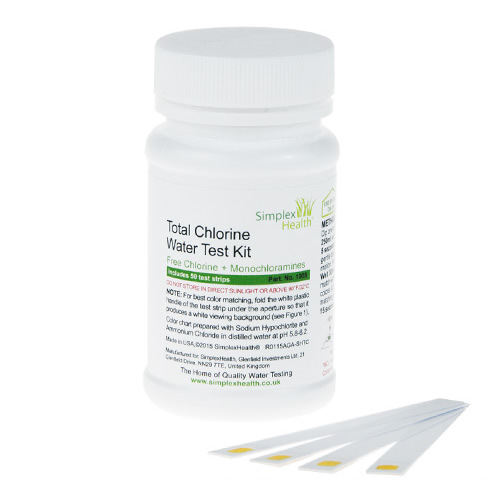
Total Chlorine Test:
These patented total chlorine water quality test strips have a high range of detection and are calibrated to be both accurate and sensitive.
Contains: 50 strips
Testing Levels: Method A: 0, 0.1, 0.2, 0.5, 0.8, 4.0, 10.0 ppm (mg/l), Method B: 0, 0.05, 0.1, 0.15, 0.2, 0.5, 1.0 ppm (mg/l)
Total Test time: 33 seconds

Water pH & Alkalinity Test (50 strips):
These pH and Alkalinity test strips are the convenient measurement tool for pH & Alkalinity. It covers a range of pH from 6 to 11 with half increments in this crucial pH testing range, ideal for tap and fresh water and providing accurate results.
Contains: 50 strips
Testing Levels: pH: 6.0, 6.5, 7.0, 7.5, 8.0, 8.5, 11.0 Alk: 0, 40, 80, 120, 180, 240, 720 ppm (mg/l)
Total Test time: 25 seconds

Wide range pH Test Strips (50 strips):
These pH are perfect to check the pH of tap & rain water. With a wide range of pH detection of 2 – 12
Contains: 50 strips
Testing Levels:
pH: 2, 3, 4, 5, 6, 6.5, 7, 7.5, 8, 8.5, 9, 9.5, 10, 11, 12
Total Test time: 30 seconds
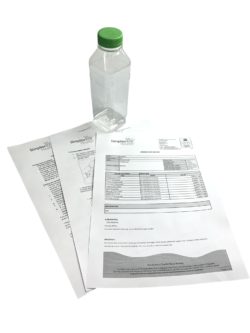
Water Suite 9-in-1 (Laboratory Test)
This laboratory test will check the levels of each of 9 elements in your water sample: pH, Alkalinity, Chloride, Fluoride, Conductivity, Total Hardness, Nitrite, Nitrate and Ammonium (as NH4). This kit has been designed to help establish if water samples are from the same source (e.g. for leak detection).
For leak detection: a minimum of 2 samples is needed for a comparison analysis.
Suitable for: Potable water analysis as well as fresh water samples, including water from tanks, taps, wells, springs, boreholes, ponds, as well as rain water.
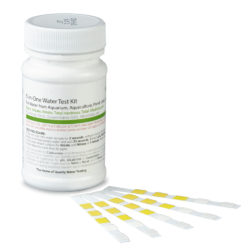
Water Test Kit (5-in-1) Aquaculture/Well (25 strips):
This mini multi-purpose water testing kit tests for 5 different elements: nitrate, nitrite, total hardness, total alkalinity and pH in one test strip.
Contains: 25 strips
Testing Levels:
- pH: 5.5, 6.5, 7.0, 7.5, 8.0, 8.5, 9.5
- Total Alkalinity: 0, 40, 80, 120, 180, 300, 720 ppm (mg/l)
- Total Hardness: 0, 25, 75, 150, 300, 1,000 ppm (mg/l)
- Nitrite: 0, 0.5, 1, 3, 5, 10, 20 ppm (mg/l)
- Nitrate: 0, 20, 40, 80, 160, 200 ppm (mg/l)
Total Test time: 1 minute 30 seconds
Water Suite 8-in-1 (Laboratory Test)
This laboratory test will check the levels of each of 8 elements in your water sample: pH, Total Hardness, Total Dissolved Solids (TDS), Calcium Hardness, Conductivity, M. Alkalinity, Total Chlorine and Chloride. This kit has been designed to help establish if water samples are from the same source (e.g. for leak detection) and is also useful to establish the scaling and corrosive tendencies/properties of water.
For leak detection: a minimum of 2 samples is needed for a comparison analysis.
Suitable for: Potable water analysis as well as fresh water samples, including water from tanks, taps, wells, springs, boreholes, ponds, as well as rain water.
Further Free Resources:
Got a question about water testing? Try our complete list of Free Water Testing Resources. Here are the most frequently read guides:
- Click here to download our FREE Water Guide
- Read an overview of the potential contaminants in your water
- Why test your water and water supply?
- Unusual colours, smells and taste of your water & further advice on finding the right test kit
- How to choose the right Water Testing Kit
- Choosing the right water testing kit for a water improvement & purification system, water cooler or a pool, spa or hot tub
- How to understand the results of your Quality Water Test Kit
- How to test for lead correctly and what immediate steps can be taken to reduce lead exposure
- How to get the best drinking water – which water filter?
- How to check if my water filter is working?
- How to test the pH of soap?
- How to look after your hot tub safely and test the water regularly
- What is best pH level for drinking water? How to measure the pH of water & other liquids correctly
- How to test the quality of Open Water for bathing or swimming
- Commercial Applications for Water Testing: Buyers Guide – Water Testing on vessels, ships as well as water tanks in remote locations
Sources & Further Reading
- World Health Organization, Chlorine in Drinking-water (Chemical Fact Sheet, Guidelines for Drinking-water Quality) —
who.int (PDF) - Drinking Water Inspectorate (DWI), Drinking Water Standards and Regulations —
dwi.gov.uk
If you can’t find what you are looking for then please contact us, as we can source many other test kits. Discounts for bulk purchase available, please contact us to find out more.
Disclaimer: Only opinions based upon our own personal experience or information detailed in academic journals or other publications is cited. This has been done exclusively for anyone who is interested in this subject but is not intended to replace proper analysis. We cannot accept responsibility and liability of any kind which may result from the application of this information. We always recommend to consult an expert to discuss any test results or get a full recommendation on the specific subject and specific to your situation by an expert.
This information is owned by SimplexHealth and you do NOT have the right to reprint, sell, auction or distribute this information.