

This article includes:
- Why do a pH test?
- When to test your pH?
- How to test your saliva & urine
- How to read the results
- Fluctuations in the readings
- What do the readings mean?
- Next step
Why do a pH test?
Simple really – pH test strips provide a simple way to measure the acidity or alkalinity of a urine or saliva sample at home.
Urine and saliva pH can vary throughout the day and may be affected because of factors such as diet, hydration, medication, activity and other aspects of your daily routine. Testing under uniform conditions and recording your results over time can help you see patterns and changes in your readings.
It is important to remember that urine and saliva pH tests do not measure the pH of your blood or the pH of your entire body. Blood pH is tightly regulated by the body and cannot be assessed using a home urine or saliva pH strip.
If you are interested in how diet can affect urine or saliva pH, our Acid & Alkaline Foods Guide can provide further information.
Many believe, the more acid is in the body – the weaker it will perform. Various authors list fatigue, allergies, overweight & mood disorders as some of the most common problems of overacidity.
Vasey* claims that making adjustments to your diet can have a really positive and alkalising effect on your body’s pH. A good alkaline diet should consist of 80% alkaline and 20% acidic foods & drinks:
- One of the simplest changes with the biggest effect is to ensure that you drink 2-3 litres of alkaline water every day. Alkaline water has a higher pH and is enriched with minerals to give you an increased sense of well-being and allowing a natural health improvement. The pH of water can easily by increased by using pH drops.
- Eating lots of fresh leafy greens & vegetables can also make a real difference to your body’s pH. Supplements of Green Drinks & liquid Chlorophyll are a great addition to the daily food intake, as they contain the best from vegetables, herbs, young grasses and leafy greens.
- Alkaline Minerals & Salts can help to get rid of acids in the deep tissue layers of the body. They also include vital minerals.
Click here to find out more about Acid & Alkaline Foods.
When to test your pH
In order to gain a better picture of your urine and saliva pH, it is recommended to test both – urine and saliva. Test the pH at different times of the day and record the readings over a longer period of time to gain a bigger picture of your progress, rather than reading each in isolation. Try and test under the same conditions each day, ie the first and second urine as well as the saliva first thing in the morning. Our SimplexHealth pH test strips contain a 30-day chart to record the readings so changes can be tracked.
How to test your saliva
Wait 2 hours after eating, drinking or brushing your teeth. Try to fill your mouth with saliva and then swallow. This helps provide a more consistent saliva sample before testing. Do not rinse your mouth with anything else as you will simply record the pH of the water/liquid you have just used.
- Put some saliva on a spoon and then test the pH by dipping the strip into it. Non-bubble saliva works best.
- Make sure both pads on the test strip are sufficiently covered in liquid, remove and then wait 15 seconds (or the time indicated on the pack instructions).
- Match the colour reading against the indicator chart in the pH test strips’ packaging. Discard the used pH test strip.
How to test your urine
Urine pH can vary throughout the day and can be affected by factors including diet, hydration, medication and other aspects of your routine. For this reason, a single reading may not provide a complete picture of your usual urine pH.
Recording your results over a longer period, such as 30 days, can make it easier to spot patterns and changes in your readings.
The first urine of the day is usually slightly more acidic than normal, therefore test the first & second urine of the day. (Please note, some authors recommend not using the first urine of the day at all**). We recommend to track both over time to see changes.
- To test, place the pH test strip in the urine stream (mid-stream) until both pads on the test strip are sufficiently covered in liquid, then remove.
- Shake off any excess fluid and wait 15 seconds;
- Compare colour change to colour chart. Discard the used pH test strip.
Try and complete the colour matching as soon as possible as the colours are not stable and can alter further.
How to read the test results
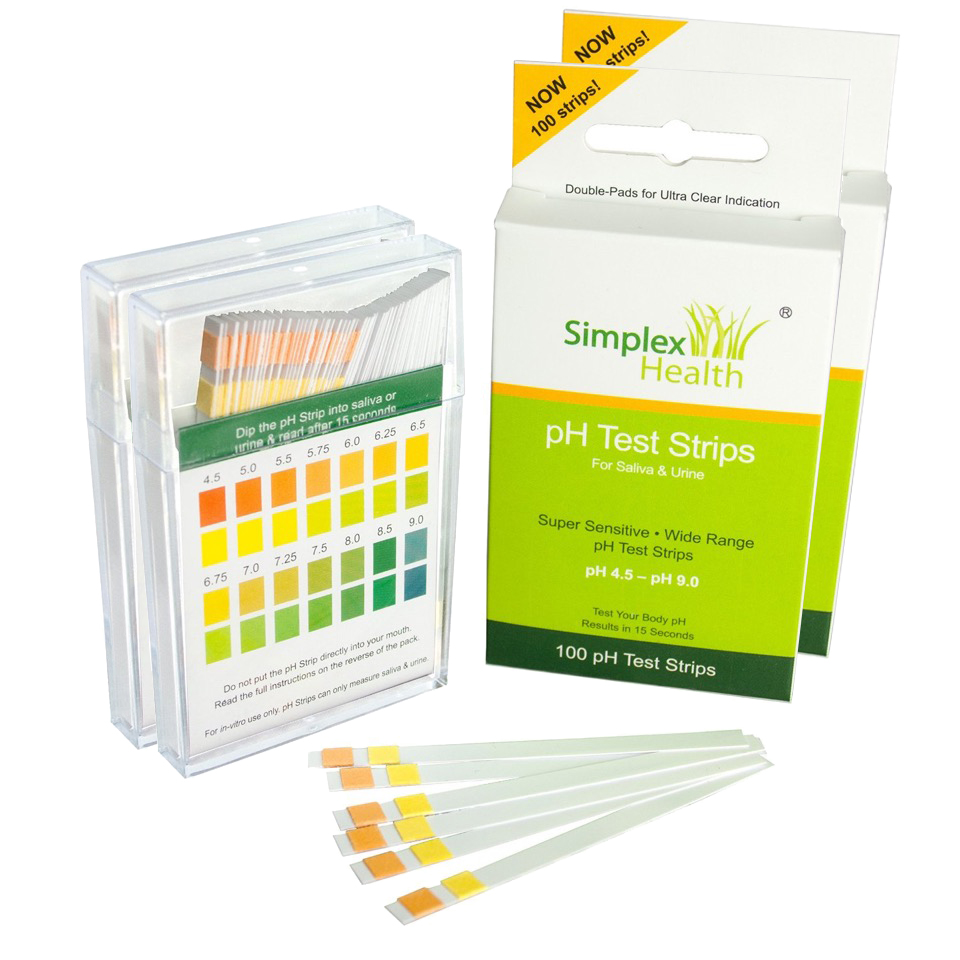
The SimplexHealth pH test strips have the special double colour indicator method for testing narrow pH ranges. This method gives the clearest and most accurate indication. Compare the colour of both pads against the indicator chart on the packaging.
Sometimes, the readings can be influenced by other substances present in urine or saliva, such as medicine, neutral salt, protein, colloid, alkaloid, organic solvent (like alcohol). In this case, it is better to use the reading of the top pad only (the one furthest away from the handle). In these instances, the top pad is more stable at performance than the lower pad.
Why can there be fluctuations in the readings?
Diet & lifestyle (stress, sport etc) can influence the pH. There can be a difference between your urine and saliva readings, because a) your mouth is more likely to contain acidic bacteria throughout the day and b) because urine pH reflects the acidity or alkalinity of urine and can change as the kidneys regulate the substances that are excreted in urine.
It is therefore recommended, to test urine as well as saliva under the same conditions each day over a period of time. This will give a bigger picture of your progress rather than concentrating on each reading in isolation. The SimplexHealth pH test strips contain a 30-day chart, where you can easily record the readings.
What do the readings mean?
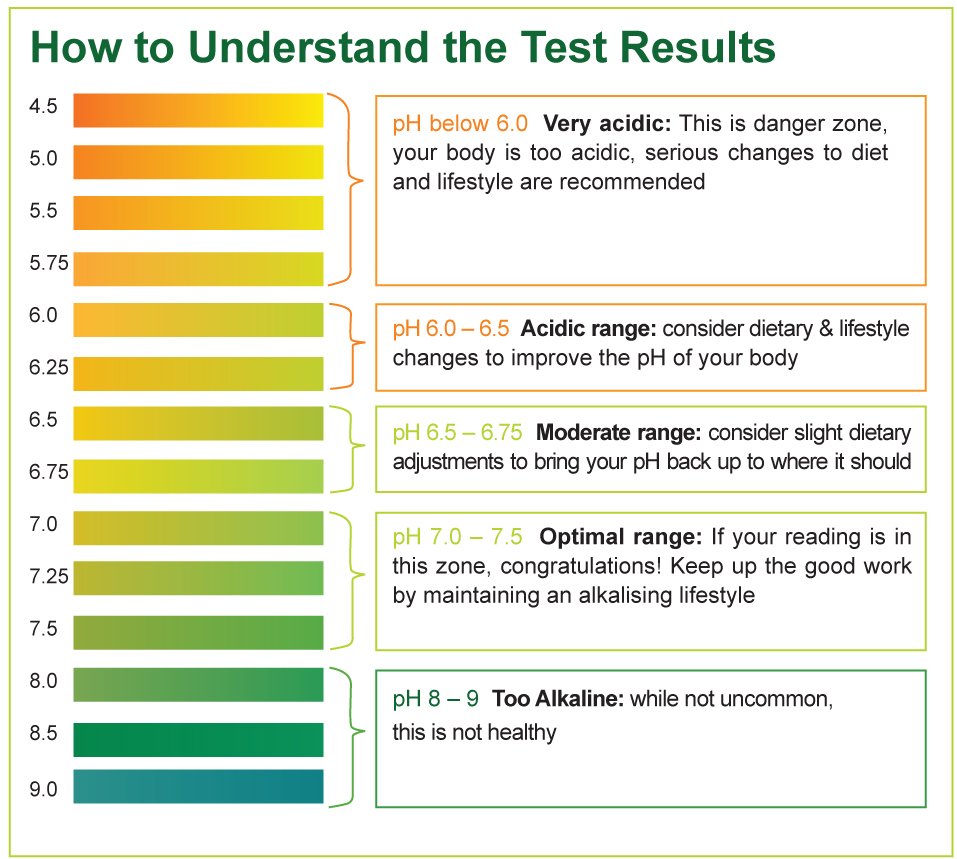
The pH reading from the test strip indicates how acidic or alkaline the urine or saliva sample is. It does not measure the pH of your blood or your entire body.
Urine and saliva can naturally vary in pH, so an individual reading should not be interpreted on its own. Recording readings under consistent conditions over time can provide a more useful picture of changes in your urine or saliva pH.
What is a normal saliva pH?
Saliva is normally slightly acidic to near-neutral, although the pH may vary depending on factors such as food, drink, oral conditions and when the sample is taken.
What is a normal urine pH?
Urine pH can vary considerably depending on factors such as diet, hydration, medication and other factors. A single urine pH reading does not by itself indicate whether someone is healthy or unhealthy.
If you have concerns about an unusual or persistent result, or about your health generally, speak to a medical professional.
What is a normal saliva pH level?
A reading between 7.0 and 7.5 is generally considered good, since saliva tends to run slightly more acidic than urine.
What is a normal urine pH level?
A urine pH of 7.0 or slightly above is generally considered good. The first urine of the day is often more acidic, so it’s worth testing both the first and second urine.
Can you test pH at home?
Yes — pH test strips give you a colour-based reading in under a minute, which you compare against an indicator chart.
How often should I test?
Testing at consistent times and under similar conditions can make results easier to compare. If you’re using the strips for personal tracking, recording readings over several weeks can help you observe patterns.
Does diet affect urine and saliva pH?
Diet can affect urine and saliva pH. However, this is different from changing the pH of your blood or entire body. Blood pH is tightly regulated by the body. Home urine and saliva pH strips are not diagnostic tests for blood pH or overall health.
Why do urine and saliva readings differ?
The mouth is more exposed to acidic bacteria throughout the day, while urine reflects the body continuously processing and removing acid. Track both over time rather than comparing single readings.
Next Step
If your urine or saliva pH readings consistently differ from your usual results, consider discussing them with a medical professional. Diet, hydration, medication and other factors can affect urine and saliva pH. Making alterations to your diet and supplementing your diet with alkalising elements will help to bring the pH back to where it should be. Seek help of a trained nutitionist or medical professional.
An analysis of the regular food we eat determines the proportion of acidifying and alkalising foods. A good alkaline diet should consist of 80% alkaline foods and 20% acidic foods – don’t forget to count drinks too! Follow our free Guide to Acid and Alkaline Foods to help you improve or maintain the pH of your body.
Regularly testing urine or saliva pH can help you track changes in your readings over time and see whether your results change alongside changes in your diet or routine. By regularly using pH test strips, average reading can be recorded over a period of time.
SimplexHealth pH Test Strips for Urine and Saliva
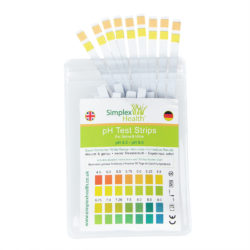
Test the pH of your urine or saliva at home with these economical and easy-to-use pH test strips. Made specifically to test saliva and urine these are by far the most accurate and economical test strips on the market. pH testing strips give you the ability to test your urine or saliva each day to track changes in your urine and saliva pH over time. This enables you to adjust your diet and supplements to achieve the optimum balance for health and peace of mind.
Each pack includes a 30 day tracker chart & comprehensive user guide. Available in packs of 25, 100, 125 and 200 test strips.

Source: *Christopher Vasey, The Acid-Alkaline Diet
- Vasey, Christopher, N.D. (2006):
The Acid-Alkaline Diet for Optimum Health: Restore Your Health by Creating pH Balance in Your Diet.
Healing Arts Press. ISBN: 978-1594771545.
(Alternative health framework referenced for dietary pH monitoring protocols).
Scientific References & Medical Sources
- MedlinePlus (U.S. NLM):
Urine pH Test Guidelines & Interpretation. - Alantar, A. et al. (2024):
Evidence-Based Practice for the Use of pH Indicator Paper Strip in Oral and Systemic Conditions.
PMC11260637. - Healthline Medical Review:
Saliva pH Levels & Oral Enamel Health. - Welch, A.A. et al.:
Urine pH is an indicator of dietary acid-base load: EPIC-Norfolk population study.
British Journal of Nutrition.
Further Information: To learn more about the Alkaline Diet click here.
Disclaimer: These products are dietary supplements and are not intended to diagnose, treat or prevent any diseases. None of the statements above have been evaluated by the US food and drug administration. Only opinions based upon our own personal experience or information detailed in publications is cited. This has been done exclusively for anyone who is interested in this subject but is not intended to replace proper analysis. WE DO NOT OFFER MEDICAL ADVICE or prescribe any treatments. This refers to any form of conversation between SimplexHealth and our customers, readers or website visitors. We cannot accept responsibility and liability of any kind which may result from the application of this information. We always recommend consulting an expert to discuss any test results or get a full recommendation on the specific subject and specific to your situation by an expert.
This information is owned by SimplexHealth and you do NOT have the right to reprint, sell, auction or distribute this information.